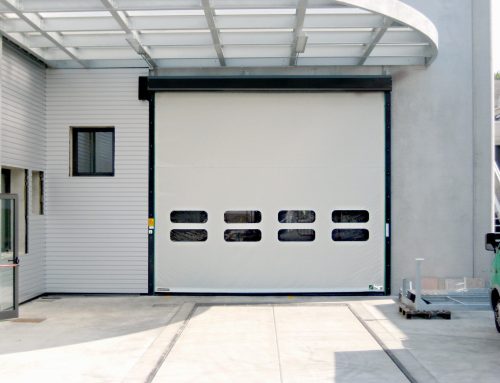

The industrial closures and fast doors sector is going through a major regulatory shift. CPR Regulation (EU) No. 305/2011 has definitively replaced the old national fire-reaction classifications, introducing a single reference system across Europe: the Euroclasses, defined by the technical standard UNI EN 13501-1.
In this context, BMP Europe presents its new range of high-performance PVC curtains with B-s2, d0 certification, the new standard for fast roll-up doors, tensile structures, roofing and facades that must guarantee the highest levels of fire safety.
In this article, we take a detailed look at what this classification means, how it compares to the old national standards, and why it has become an essential requirement for designers, installers and distributors alike.
The regulatory framework: from national classes to Euroclasses
Until a few years ago, every European country used its own system to classify the fire reaction of construction materials: Class 1 in Italy (DM 1984), M1/M2 in France (NF P92-501), DIN 4102 in Germany, BS 476 in the United Kingdom. Different systems, different test methods, and little comparability between markets.
The CPR Regulation put an end to this fragmentation: for all products falling under harmonized European standards or requiring CE marking, the old national classifications are now definitively obsolete. New projects and installed structures must strictly use products tested and certified according to the Euroclass system.
It’s worth noting that the transition between the old and new system is not a simple mathematical equivalence: European test methods are different, and generally stricter, than the historical national ones. At a commercial and technical-specification level, however, an indicative correspondence can be used as a reference, which we summarize in the comparison table below.
What B-s2, d0 technically means
The Euroclass classification is not a single label, but a combination of three distinct parameters, each describing a specific aspect of the material’s behaviour in fire. This breakdown provides a level of technical transparency that the old national classes could not offer.
- B – Contribution to flame spread
The letter B indicates a combustible material that provides only a minimal contribution to fire spread. PVC certified as Class B does not feed the flame: it tends to char and self-extinguish as soon as the direct heat source is removed. This is the highest performance level achievable for flexible polymers, second only to classes A1/A2, which are reserved for non-combustible materials.
- s2 – Smoke production
The “s” parameter (smoke) measures the amount of smoke produced during combustion, on a scale ranging from s1 (almost no smoke) to s3 (dense, persistent smoke). Class s2 represents the best technical compromise currently available for flexible polymers formulated with flame-retardant additives, such as the PVC curtains used in industrial fast doors.
- d0 – Flaming droplets
The “d” parameter (droplets) certifies whether burning particles are released during the test. Class d0 indicates a complete absence of molten, incandescent plastic droplets: a crucial requirement for people’s safety, as it prevents the material from releasing burning droplets onto escape routes beneath the structure.
Comparison table: Euroclass vs. old national standards
| Euroclass (EN 13501-1) | Italy (DM 1984) | Germany (DIN 4102) | France (NF P92-501) | United Kingdom (BS 476 pt 6/7) | Material description |
|---|---|---|---|---|---|
| A1 / A2 | Class 0 | A1 / A2 | M0 / M1 | Non-combustible | Non-combustible / near-zero contribution |
| B – s1/s2, d0 | Class 1 | B1 | M1 | Class 0 / Class 1 | Combustible, non-flammable |
| C – s1/s2, d0 | Class 1/2 | B1 | M2 | Class 1 / Class 2 | Difficult to ignite |
| D – s1/s2, d0 | Class 2/3 | B2 | M3 | Class 3 | Moderately flammable |
| E | Class 4 | B2 | M4 | Class 4 | Highly flammable |
As shown in the table, the old Italian Class 1 and French M1 generally transition to Euroclass B-s1/s2, d0, while French M2 and Italian Class 2 typically fall under the C classes. Requiring a PVC tarpaulin certified B-s2, d0 therefore means demanding a real step up in safety requirements compared to the old M2, bringing the material to the highest performance level available for flexible polymers.
Why this certification matters for designers and distributors
For companies involved in selling, distributing and installing industrial fast doors, having a B-s2, d0 certified product means being able to meet the most demanding technical specifications right away, without having to scramble to catch up with regulatory updates. It also means offering end customers an objectively higher, measurable level of safety, recognized throughout the European Union regardless of the country of installation.
BMP Europe’s B-s2, d0 PVC curtains combine this safety standard with a wide range of aesthetic and functional customization options: neutral, bright and technical RAL colours, translucent versions, antistatic treatment, and specific variants for food-industry use (FDA).
Frequently asked questions about B-s2, d0 certification
What is B-s2, d0 certification?
It’s a Euroclass classification defined by the UNI EN 13501-1 standard, describing a material’s fire behaviour through three parameters: combustibility class (B), smoke production (s2), and flaming droplets (d0). For PVC curtains used in industrial fast doors, it currently represents the highest realistically achievable standard.
What’s the difference between Italian Class 1 and B-s2, d0?
Italian Class 1 (DM 1984) was a national classification system, now obsolete for products subject to CE marking. Commercially, it generally transitions to Euroclass B-s1/s2, d0, but European test methods are stricter and more detailed, separately assessing combustibility, smoke, and droplet formation.
Is B-s2, d0 certification mandatory throughout Europe?
Yes. CPR Regulation (EU) No. 305/2011 requires the use of the Euroclass system for all harmonized construction products or those subject to CE marking, replacing the old national classifications, in every EU member state.
What does “d0” mean for people’s safety?
Class d0 certifies the complete absence of flaming, molten plastic droplets during combustion. This is a critical parameter for protecting escape routes beneath the structure, preventing the material from releasing burning droplets during a fire.
Are BMP’s B-s2, d0 PVC curtains available in different finishes?
Yes. In addition to the safety standard, the range is available in a wide choice of RAL colours, a translucent version, antistatic treatment, and a specific food-industry variant (FDA), with no compromise between aesthetics, functionality and regulatory compliance.
Conclusion
The shift from national classifications to Euroclasses is more than a bureaucratic formality — it represents a real advancement in safety standards for the industrial closures sector. With B-s2, d0 certification, BMP Europe confirms its commitment to providing dealers and distributors worldwide with a technically advanced product, compliant with the latest European regulations and ready for tomorrow’s projects.
Want more technical or commercial information about B-s2, d0 certified PVC curtains? Contact the BMP Europe team to speak with our experts, or explore the full product range on our website.